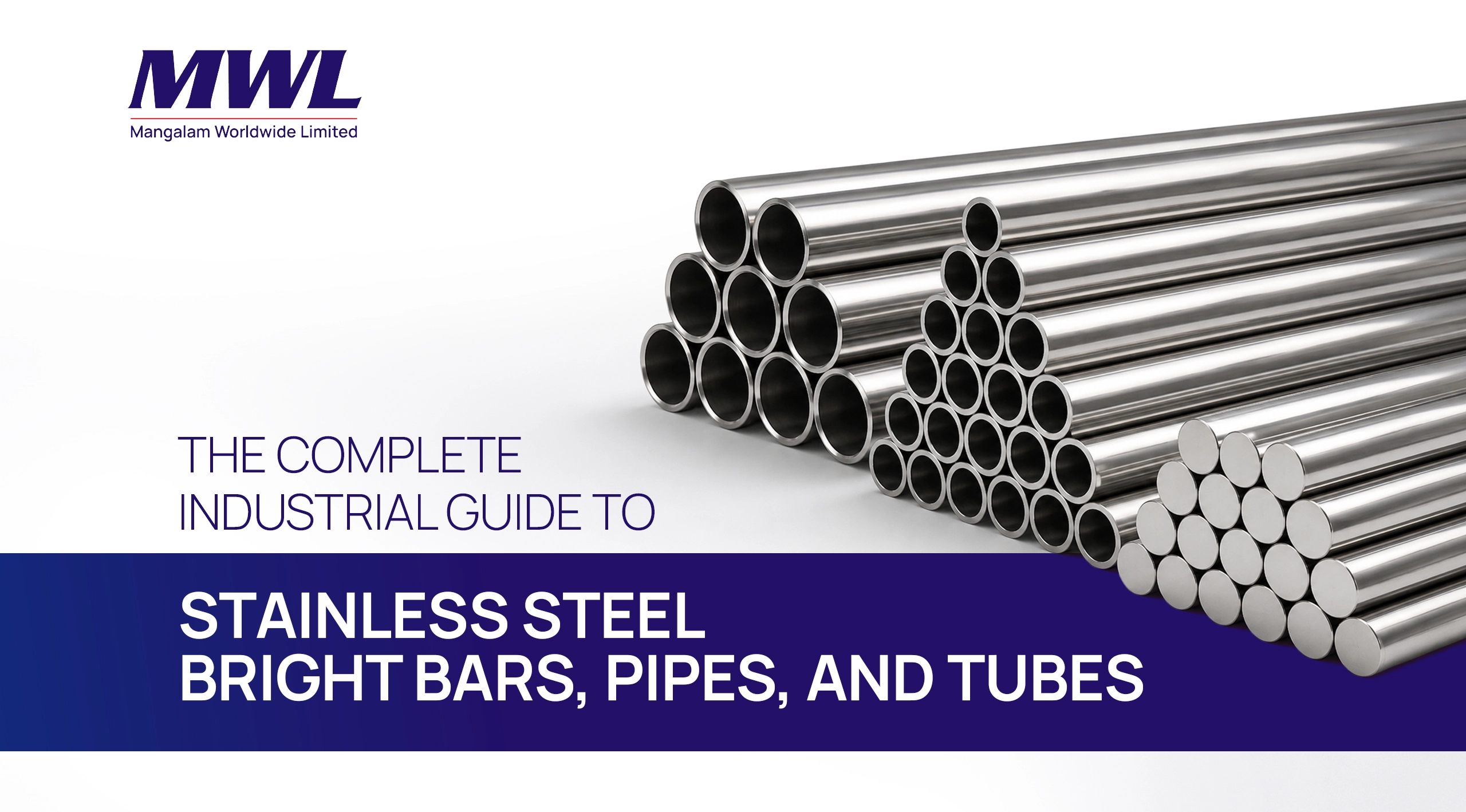
Material selection decisions often have long-term consequences in industrial projects. Whether the objective is achieving tighter machining tolerances, maintaining process reliability under corrosive conditions, or ensuring structural consistency across fabricated assemblies, choosing the right stainless steel product is critical.
Among the most commonly specified industrial stainless steel products are bright bars, pipes, and tubes. While they are often grouped together in procurement discussions, each serves a distinct engineering purpose. Understanding their characteristics, manufacturing processes, and applications can help manufacturers, fabricators, and project teams make more informed purchasing decisions.
Understanding Stainless Steel Bright Bars
Bright bars are precision-finished stainless steel bars produced through processes such as cold drawing, peeling, grinding, and polishing. Unlike conventional hot-rolled bars, bright bars offer tighter dimensional tolerances and superior surface finish.
Why Bright Bars Are Preferred for Precision Components
Many industrial applications involve machining operations where consistency directly affects productivity. Variations in diameter or surface quality can increase machining time and material wastage.
This is where SS bright bars India manufacturers play an important role by supplying products that meet stringent dimensional requirements for:
- Shafts and spindles
- Fasteners
- Valves and fittings
- Automotive components
- Pumps and process equipment
- Precision engineering assemblies
The enhanced surface finish also improves appearance and reduces additional finishing requirements during fabrication.
Stainless Steel Pipes: Built for Process Transport
Pipes are primarily designed to carry liquids, gases, slurries, and process media through industrial systems. Their selection is influenced by pressure ratings, wall thickness, operating temperatures, and corrosion resistance requirements.
One of the most important distinctions in industrial piping systems is the choice between welded and seamless construction.
Why Stainless Steel Seamless Pipes Matter
Unlike welded pipes, stainless steel seamless pipes are manufactured without a longitudinal weld seam. The material is formed from a solid billet, creating a uniform structure throughout the pipe wall.
This manufacturing method offers several advantages:
- Enhanced pressure-handling capability
- Greater structural integrity
- Improved reliability in critical process systems
- Reduced risk of weld-related defects
- Better performance in demanding operating environments
Industries such as chemical processing, petrochemicals, pharmaceuticals, power generation, and oil and gas frequently specify seamless pipes where operational reliability is essential.
Stainless Steel Tubes: Precision Beyond Fluid Transport
Although pipes and tubes are often confused, tubes are generally selected when dimensional accuracy is a key requirement.
Unlike pipes, which are sized primarily for flow capacity, tubes are manufactured with precise outside diameter, inside diameter, and wall thickness specifications.
Where Tubes Deliver Value
Stainless steel tubes are commonly used in applications requiring:
- Accurate fitment
- Structural stability
- Heat transfer efficiency
- Controlled tolerances
Typical applications include:
- Heat exchangers
- Instrumentation systems
- Pharmaceutical equipment
- Food processing machinery
- Architectural structures
- Automotive assemblies
In these applications, precision often matters as much as material strength.
Selecting the Right Stainless Steel Product
Choosing between bright bars, pipes, and tubes should be based on operational requirements rather than product familiarity.
Choose Bright Bars When:
- Precision machining is required
- Surface finish is important
- Tight tolerances must be maintained
- Components require consistent dimensions
Choose Pipes When:
- Transporting fluids or gases
- Pressure performance is critical
- Process reliability is a priority
- Industrial distribution systems are being designed
Choose Tubes When:
- Dimensional accuracy is essential
- Structural performance is required
- Equipment fabrication demands precise fitment
- Heat transfer systems are involved
Matching product characteristics to application requirements helps improve efficiency while reducing long-term operational challenges.
The Importance of a Reliable Manufacturing Partner
Product quality is influenced not only by material grade but also by manufacturing controls, inspection procedures, and process consistency. Working with an experienced stainless steel pipe supplier and stainless steel product manufacturer can significantly reduce quality-related risks.
Mangalam Worldwide focuses on delivering industrial steel solutions that meet the demanding requirements of modern manufacturing and infrastructure sectors. Through stringent quality standards, advanced manufacturing capabilities, and a commitment to consistency, the company supports customers seeking dependable stainless steel products for critical industrial applications.
Conclusion
Bright bars, pipes, and tubes each play a specialized role in industrial operations. While bright bars support precision machining, pipes enable reliable process transport, and tubes provide dimensional accuracy for engineered systems.
Understanding these differences allows procurement teams, engineers, and manufacturers to select the most suitable industrial stainless steel products for their applications. By partnering with experienced manufacturers and focusing on product quality, organizations can improve operational reliability, manufacturing efficiency, and long-term project perfosssrmance.