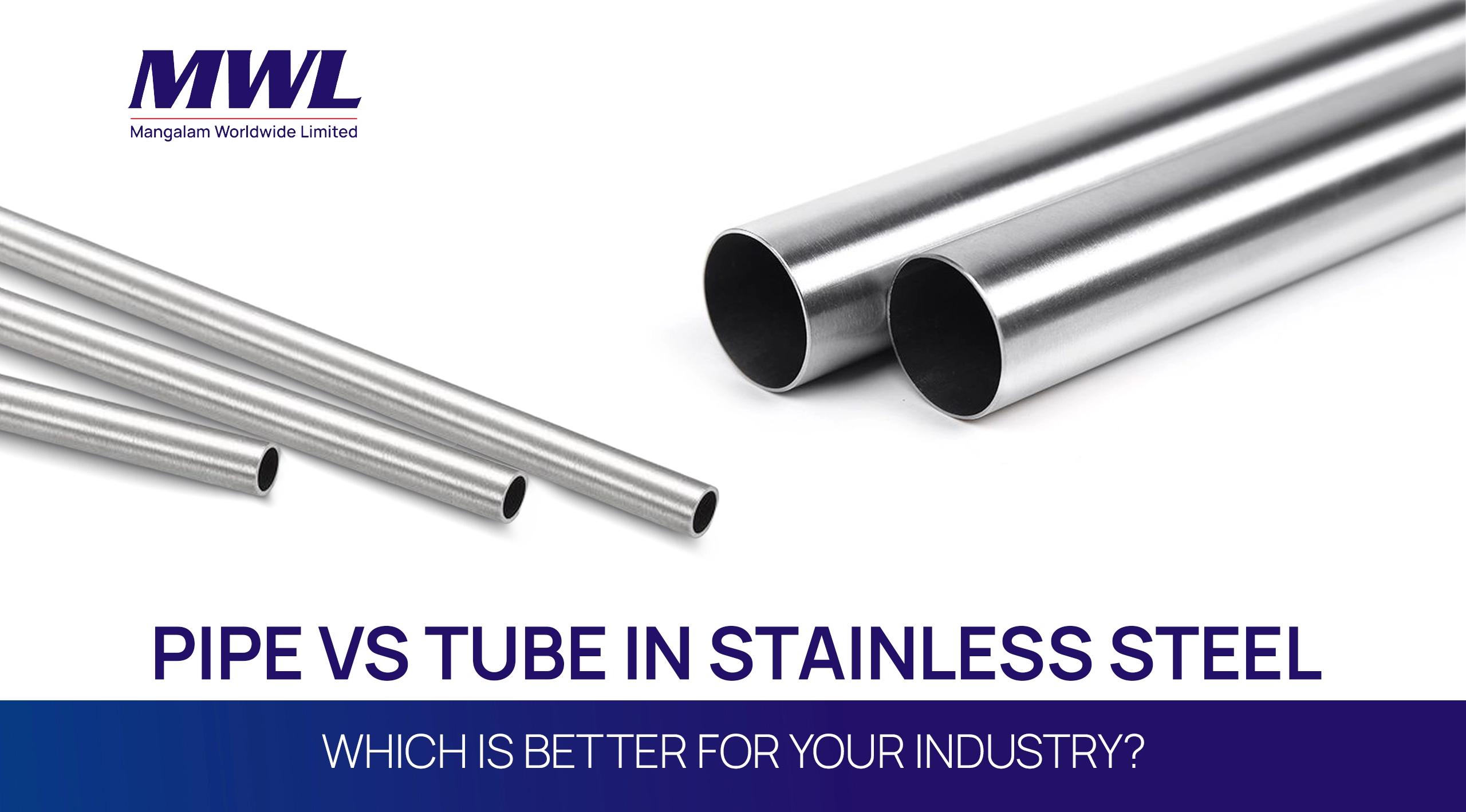
When sourcing stainless steel products for industrial applications, one question often arises: pipe vs tube – which is the right choice? While the terms are frequently used interchangeably, pipes and tubes are designed for different purposes and offer distinct advantages depending on the application.
Understanding these differences helps engineers, fabricators, procurement professionals, and manufacturers select the most suitable product for performance, efficiency, and cost-effectiveness. This guide discovers the key differences between stainless steel pipes and tubes, their applications, and how to determine the best fit for your industry.
Understanding the Difference Between Pipes and Tubes
Although both products are hollow stainless steel sections, their manufacturing standards, dimensional measurements, and intended uses differ significantly.
What Is a Stainless Steel Pipe?
A pipe is primarily designed to transport fluids, gases, or semi-solid materials. Pipe dimensions are generally specified using Nominal Pipe Size (NPS) and schedule numbers that define wall thickness.
Pipes are typically selected based on:
- Flow capacity
- Pressure requirements
- Corrosion resistance
- Operating environment
Industries such as oil and gas, chemical processing, water treatment, and power generation rely heavily on stainless steel pipes for process transportation systems.
What Is a Stainless Steel Tube?
A tube is designed with greater emphasis on dimensional accuracy and structural performance. Tubes are specified using exact outside diameter (OD), inside diameter (ID), and wall thickness measurements.
Applications often require tighter tolerances because tubes are used in:
- Structural frameworks
- Heat exchangers
- Instrumentation systems
- Automotive components
- Food and pharmaceutical equipment
Many industries prefer industrial stainless steel tubing when precision and mechanical performance are critical.
Pipe vs Tube: Key Differences
Understanding the SS pipe and tube comparison becomes easier when examining their core characteristics.
Dimensional Accuracy:
Tubes are manufactured with stricter dimensional tolerances than pipes. This precision makes them ideal for applications requiring exact fitment and structural integrity.
Pipes, on the other hand, prioritize fluid transport efficiency over dimensional precision.
Measurement Standards:
Pipes are measured using NPS and schedule thickness.
Tubes are measured by:
- Outside diameter
- Inside diameter
- Wall thickness
This difference allows engineers to specify tube dimensions with greater accuracy.
Strength and Structural Applications:
Tubes generally provide better structural performance due to tighter manufacturing tolerances and precise dimensions.
As a result, stainless steel tubes are widely used in architectural, engineering, and fabrication projects.
Cost Considerations:
Because tubes require more precise manufacturing processes, they often carry a higher production cost than standard pipes. However, the additional precision can reduce fabrication challenges and improve overall project efficiency.
When to Choose Stainless Steel Pipes
Pipes are often the preferred solution when the primary objective is transporting liquids or gases efficiently.
Common applications include:
- Water distribution systems
- Chemical transfer lines
- Oil and gas processing facilities
- Industrial utility networks
- Steam and pressure systems
In these environments, durability, corrosion resistance, and pressure-handling capability are often more important than precise dimensional control.
When to Choose Stainless Steel Tubes
Tubes become the better choice when projects demand accuracy, strength, and superior surface quality.
Popular applications include:
- Heat exchanger systems
- Pharmaceutical processing equipment
- Food and beverage manufacturing
- Automotive components
- Structural fabrication
- Instrumentation systems
A seamless stainless steel tube is particularly valuable in applications involving high pressure, critical tolerances, or demanding operating conditions. The absence of a welded seam improves strength, consistency, and corrosion resistance.
Factors to Consider Before Making a Decision
Choosing between a pipe and tube depends on several operational requirements.
Application Purpose:
If the product will transport fluids or gases, a pipe is often the most practical solution.
If the application requires structural performance or precise dimensions, tubing is generally the better option.
Pressure and Temperature Conditions:
Both pipes and tubes can perform in demanding environments, but specialized tubing products may offer advantages in critical systems requiring tighter tolerances.
Regulatory Requirements:
Certain industries, including pharmaceuticals, food processing, and energy production, may require specific standards and certifications that influence product selection.
Fabrication Requirements:
Projects involving bending, machining, or complex assembly often benefit from the dimensional consistency provided by stainless steel tubing.
Partnering with the Right Stainless Steel Supplier
Whether selecting pipes or tubes, product quality remains a critical factor. Working with an experienced stainless steel tubing supplier ensures access to products manufactured according to recognized industry standards and stringent quality controls.
Mangalam Worldwide provides excellent stainless steel solutions designed for performance, dependability, and consistency to a variety of sectors. With advanced manufacturing capabilities and a strong focus on quality, the company supports customers seeking dependable stainless steel products for demanding industrial applications.
Conclusion
The debate around pipe vs tube ultimately comes down to application requirements. While tubes provide better structural performance and accuracy, pipes are superior in fluid transfer systems. Understanding the differences helps businesses make informed decisions that improve efficiency, durability, and long-term value.
By evaluating operational needs, industry standards, and performance expectations, organizations can confidently select the right stainless steel solution for their specific applications.