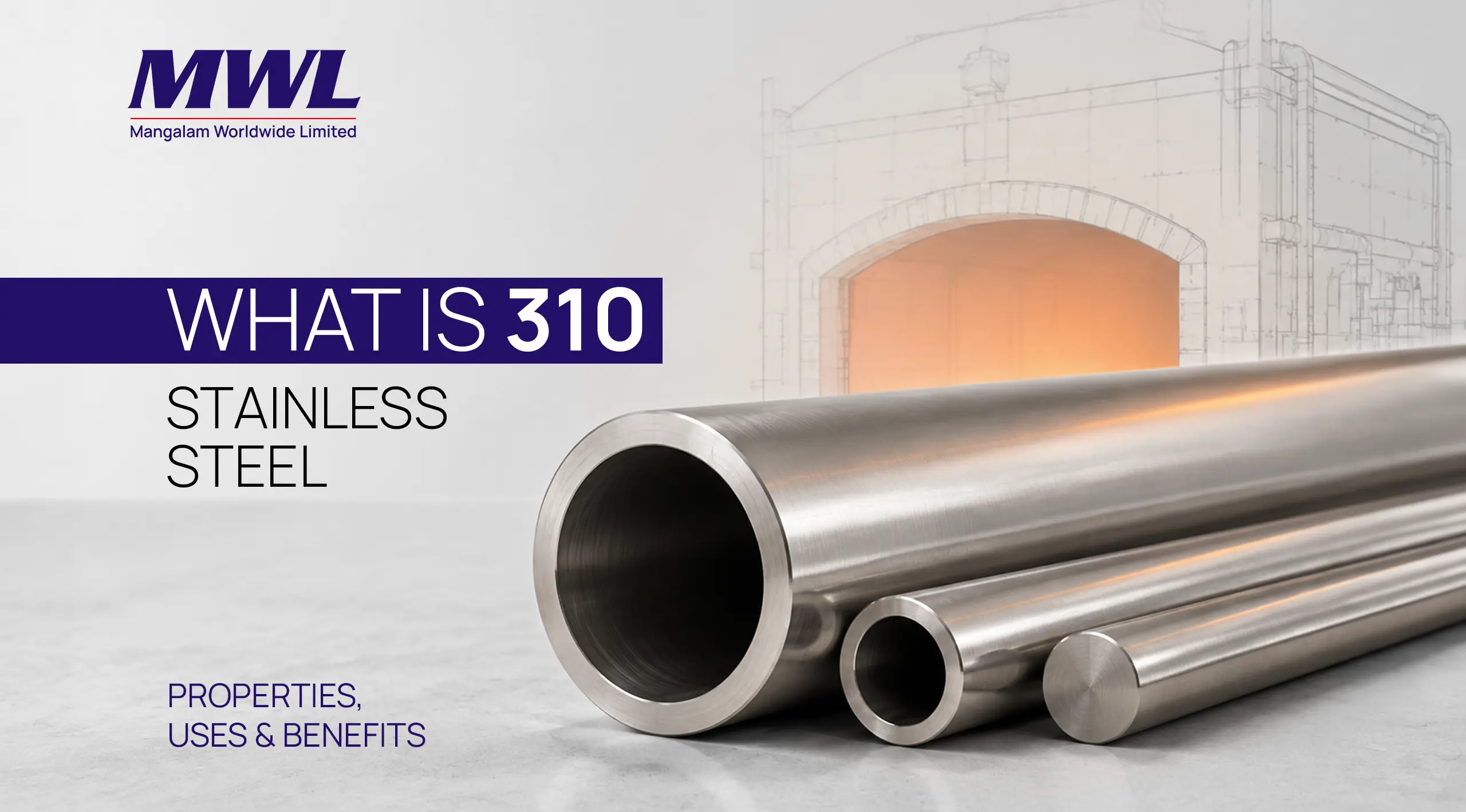
Choosing stainless steel for equipment exposed to sustained heat requires a different set of priorities than selecting material for ordinary ambient-temperature service. Oxidation behaviour, strength retention and the effect of repeated heating become important considerations alongside corrosion resistance.
310 stainless steel is an austenitic chromium-nickel stainless steel developed for elevated-temperature environments. Its relatively high chromium and nickel content distinguishes it from common 300-series grades and makes it particularly relevant when equipment must retain useful performance under severe thermal conditions.
Understanding 310 Stainless Steel Composition
The performance of Grade 310 begins with its chemistry. 310 stainless steel composition typically contains approximately 24 – 26% chromium and 19 – 22% nickel, with iron forming the balance along with controlled amounts of other elements.
These two major alloying elements perform different functions.
Chromium supports the formation of a protective oxide layer on the steel surface and contributes significantly to oxidation resistance at elevated temperatures. Nickel helps stabilise the austenitic structure and supports performance under thermal exposure.
This chemistry explains why Grade 310 should not simply be considered a higher-alloy alternative to 304 or 316. Its material design is specifically advantageous where heat exposure is a central operating condition.
Variants such as 310S and 310H modify carbon content to suit different fabrication or elevated-temperature mechanical-property requirements.
Key 310 Stainless Steel Properties
Understanding 310 stainless steel properties helps engineers determine whether the grade suits a particular operating environment.
High-Temperature Oxidation Resistance:
One of its defining characteristics is resistance to oxidation under elevated-temperature conditions. The high chromium level helps the material maintain a protective surface oxide when exposed to hot air and certain oxidising atmospheres.
Austenitic Structure:
Grade 310 belongs to the austenitic stainless steel family. This structure provides useful fabrication characteristics and toughness across a broad temperature range.
Good Corrosion Resistance:
Although 310 is primarily selected for elevated-temperature duties, it also offers corrosion resistance in many environments. However, it is not automatically the best grade for every corrosive service. Chemical exposure, chlorides, temperature and process conditions must still be evaluated individually.
Fabrication Capability:
310 can be fabricated and welded using appropriate procedures, allowing it to be converted into bars, pipes, tubes and engineered components required for high-temperature equipment.
What Makes 310 Stainless Steel Heat Resistance Important?
310 stainless steel heat resistance is not simply about whether the metal melts or remains physically intact. Engineers need to consider what happens to the material during prolonged exposure to elevated temperatures.
Oxidation can progressively damage an inadequately selected alloy. Thermal cycling can also place components under repeated expansion and contraction.
Grade 310’s chromium-nickel chemistry makes it suitable for many high-temperature environments where maintaining oxidation resistance is essential. Published material guidance commonly places its oxidation resistance at approximately 1,150°C in continuous service and around 1,035°C in intermittent service, although actual suitability depends on atmosphere, loading, thermal cycling and component design.
These temperature figures should therefore be treated as material-selection guidance rather than universal operating limits.
Major 310 Stainless Steel Uses
The most appropriate 310 stainless steel uses are applications where elevated temperature is a defining design condition rather than an occasional event.
Examples can include:
- Furnace components and internal parts
- Heat-treatment equipment
- Burner components
- Kiln components
- Radiant tubes
- High-temperature process piping
- Thermal processing equipment
- Components exposed to hot gases
In these environments, material selection must consider not only maximum temperature but also duration of exposure, mechanical loading, atmosphere and the frequency of heating and cooling cycles.
Understanding 310 Stainless Steel Applications
Different 310 stainless steel applications place different demands on the material.
For example, a furnace component operating continuously at high temperature faces different metallurgical conditions from a component heated and cooled repeatedly. Similarly, exposure to an oxidising atmosphere differs from service involving sulphurous, carburising or reducing conditions.
Engineers should therefore assess:
- Operating temperature: Consider normal operating conditions as well as potential temperature excursions.
- Atmosphere: Determine which gases or process chemicals contact the stainless steel at temperature.
- Mechanical loading: Evaluate whether the component carries significant stress while hot.
- Thermal cycling: Frequent temperature changes can influence material and component behaviour.
- Fabrication requirements: Welding, machining, forming and final geometry should be considered before selecting the grade.
This application-specific evaluation prevents a common procurement mistake: selecting stainless steel solely from a maximum-temperature figure.
Benefits of Selecting Grade 310
For appropriately engineered applications, Grade 310 offers a useful combination of:
- Resistance to high-temperature oxidation
- Austenitic stability
- Good toughness
- Fabrication and welding capability
- Corrosion resistance in suitable environments
- Availability in multiple product forms
Its main advantage is therefore not one isolated property, but the balance of characteristics required for equipment operating under thermal stress.
310 Stainless Steel from Mangalam Worldwide
Mangalam Worldwide manufactures a broad portfolio of austenitic stainless steels and lists 310, 310S and 310H among its available grades.
As a fully integrated specialty stainless steel manufacturer, Mangalam Worldwide operates in-house melting, casting, rolling and downstream processing facilities. Its product portfolio includes continuous cast billets, bright and hot-rolled bars, forged products, seamless pipes, heat exchanger tubes and U-tubes, allowing stainless steel requirements to be addressed across multiple product forms.
Material traceability is also supported through Mill Test Certificates for products supplied by the company.
Conclusion
310 stainless steel earns its place in high-temperature engineering through its chromium-nickel chemistry and resulting resistance to elevated-temperature oxidation. However, selecting it correctly requires more than matching a grade to a temperature chart.
Process atmosphere, loading, thermal cycling, fabrication requirements and service conditions should all form part of the material decision.
For buyers requiring Grade 310, 310S or related stainless steel products, Mangalam Worldwide combines integrated manufacturing capabilities with a broad stainless steel grade portfolio to support material requirements for demanding engineering applications.