Inside a heat exchanger, a U-tube works under conditions that leave little room for dimensional or metallurgical inconsistency. Pressure, temperature changes, corrosive media and repeated thermal cycles can expose weaknesses that may not be apparent when the tube is first installed.
For this reason, evaluating a U tube for heat exchanger service requires more than checking its outside diameter and stainless steel grade. Material chemistry, wall consistency, bend geometry, surface condition and testing all influence how reliably the tube performs after installation.
Why U-Tube Quality Matters in Heat Exchanger Performance
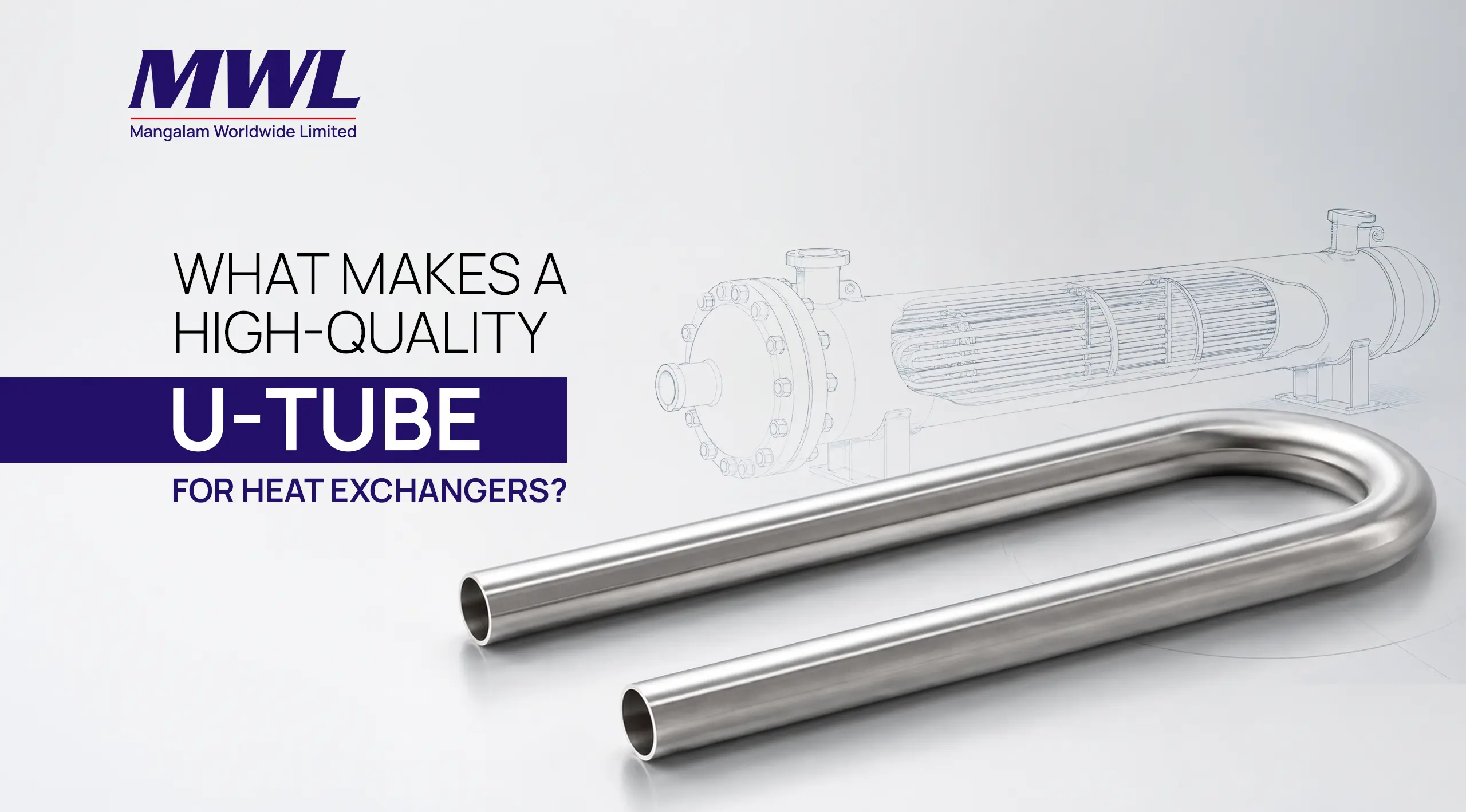
A U tube heat exchanger uses tubes bent into a U-shaped configuration, allowing the fluid to travel through the tube bundle and return from the same end. This arrangement can accommodate thermal expansion effectively while supporting compact equipment design.
However, the bend introduces an important manufacturing challenge. Forming changes the geometry of the tube locally. Poorly controlled bending can contribute to wall thinning, ovality or dimensional variation around the bend.
A high-quality heat exchanger U tube must therefore maintain the required geometry and material integrity across both its straight sections and U-bend.
1. Start with the Correct U-Tube Material Selection
There is no single stainless steel grade suitable for every heat exchanger environment. U tube material selection should account for:
- Operating and design temperatures
- Internal and external pressures
- Chemical composition of the process fluid
- Chloride exposure and corrosion risk
- Required mechanical properties
- Applicable project specifications
Grades such as 304/L, 316/L/Ti and 321/H may be considered depending on service conditions, while Duplex and Super Duplex grades can address more demanding corrosion environments.
Mangalam Worldwide manufactures stainless steel U tube products across Austenitic, Ferritic, Martensitic, Duplex, Super Duplex and High Alloy stainless steel grades, enabling buyers to match tube metallurgy more closely with their operating conditions.
2. Dimensional Accuracy Must Continue Through the Bend
For heat exchanger fabricators, dimensional control affects tube-sheet assembly, bundle alignment and installation efficiency.
U tube dimensional accuracy involves more than outside diameter. Manufacturers must control wall thickness, bend radius, straight-leg dimensions and the geometry created during bending.
The U bend tubes for heat exchangers should be manufactured according to the approved drawing and specified tolerances. Accurate geometry becomes particularly important when a tube bundle contains numerous U-tubes that must align correctly during assembly.
Mangalam Worldwide manufactures U-tubes with outside diameters from 15.87 mm to 38.10 mm, wall thicknesses from 0.89 mm to 6 mm, with U-tube lengths supplied according to customer specifications.
3. Bend Quality Is a Critical Inspection Point
The U-bend deserves particular attention because bending places different stresses on the inner and outer surfaces of the tube.
Quality evaluation should examine whether the specified bend has been achieved without unacceptable deformation. The bend area should retain the dimensional and mechanical characteristics required by the applicable specification.
This is particularly important for seamless U tubes, where buyers often select seamless construction for pressure-containing and demanding heat-transfer duties. Reliable bend control helps preserve the advantages expected from the original seamless tube.
4. Heat Treatment and Surface Condition Matter
Manufacturing quality does not end when the tube reaches its final shape. Heat treatment and finishing can influence corrosion performance, mechanical properties and suitability for the intended service.
Depending on material, specification and manufacturing route, appropriate heat treatment may be required. ASTM A213/A213M, for example, covers seamless ferritic and austenitic alloy-steel boiler, superheater and heat-exchanger tubes and specifies heat-treatment and testing requirements for covered materials.
Mangalam Worldwide supplies its U tube heat exchanger tubes in annealed and pickled condition and operates pickling and passivation facilities for stainless steel pipes and tubes.
5. Verify Applicable U-Tube Quality Standards
A buyer should never treat compliance as a generic statement. The required U tube quality standards need to be established against the actual material, equipment design and project specification.
Relevant requirements may cover chemical composition, tensile properties, hardness, dimensions, heat treatment and non-destructive or pressure testing.
For example, ASTM A213/A213M applies to specified seamless alloy-steel and stainless steel heat-exchanger tubes. ASTM A688/A688M addresses austenitic stainless steel feedwater heater tubes, including tubes bent into U-form for applicable feedwater-heater service.
Mangalam Worldwide manufactures its heat exchanger tubes and U-tubes to requirements including ASTM, ASME, DIN EN and JIS specifications, depending on customer requirements.
6. Evaluate the Manufacturer, Not Just the Tube
Selecting a capable U tube manufacturer means evaluating how the product is controlled from material production through tube finishing.
Mangalam Worldwide operates as a fully integrated specialty stainless steel mill. Under its Mangalam Tubicore brand, its tubular manufacturing infrastructure includes piercing and pilgering mills, draw benches, and bright/solution annealing facilities. Its Pilger and Draw Bench machines incorporate servo motors and PLC controls to support dimensional accuracy and tube finish.
This integrated manufacturing capability provides greater control over metallurgy, processing and finished dimensions.
What Should Buyers Ask a U-Tube Supplier?
Before finalising a U tube supplier, procurement and engineering teams should establish:
- Which grade and specification match the service environment?
- What OD, wall thickness and bend-radius tolerances are required?
- What inspection and testing requirements apply?
- What heat treatment and surface condition are specified?
- Can the supplier manufacture according to project drawings?
- Is material and manufacturing documentation available as required?
These questions move procurement beyond price comparison and towards application-specific product evaluation.
Conclusion
A high-quality U tube for heat exchanger applications is the result of controlled metallurgy, precise tube production, accurate bending, appropriate heat treatment, surface finishing and verification against the required specification.
Mangalam Worldwide manufactures seamless heat exchanger tubes and U-tubes across multiple stainless steel families, with U-tubes produced according to customer-specific requirements. For heat exchanger manufacturers and project buyers, this combination of material flexibility and integrated manufacturing provides a reliable route to sourcing tubes engineered around actual operating requirements.
For your next heat exchanger requirement, connect with Mangalam Worldwide to discuss stainless steel grade, dimensions, U-bend specifications and project-specific tube requirements.