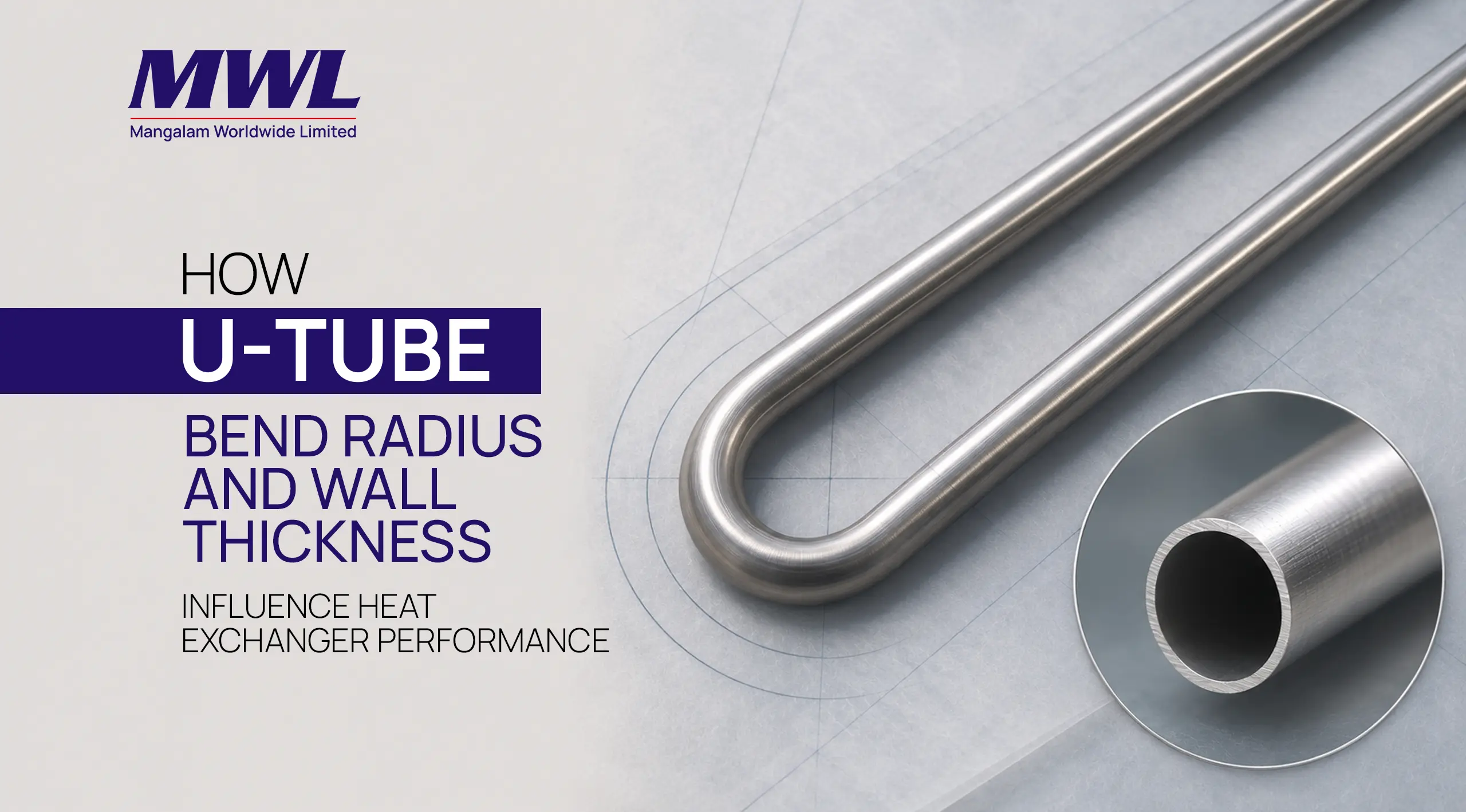
The bend radius and wall thickness on a heat exchanger drawing define more than the shape of a tube. They influence the energy needed to circulate fluid, the resistance to heat flow and the material remaining after bending.
In a U-tube heat exchanger, these dimensions must work together. A compact bend creates greater forming demands; additional wall thickness changes both thermal resistance and internal flow area. Understanding those relationships helps engineers specify tubes that meet the required heat duty without overlooking pressure containment or operating costs.
How Does U-Tube Bend Radius Affect Performance?
U-tube bend radius normally refers to the radius measured along the tube centerline. Its relationship to outside diameter, expressed as R/D, helps describe how tight the bend is.
At a fixed tube diameter, reducing the radius increases forming strain. During bending, the outer curve can thin, while the inner curve can thicken or wrinkle. The cross-section may also become oval. These changes make the finished bend’s geometry and minimum wall thickness important acceptance criteria.
The return bend also changes fluid direction through approximately 180 degrees, introducing hydraulic losses and secondary flow. Those effects depend on curvature, fluid properties and flow conditions. Secondary flow also changes local heat transfer, making bend behavior relevant to the thermal assessment.
A larger radius changes the flow pattern but also increases bend length and space requirements. Consequently, there is no universally optimal radius. Engineers should assess the complete flow path rather than assume that a larger bend always lowers total pressure drop.
What Does Wall Thickness Change Thermally?
Heat exchanger tube wall thickness contributes to the resistance between the hot and cold fluids. For the same material and outside diameter, increasing thickness raises the wall’s conductive resistance.
However, the metal wall is only one part of the heat-transfer path. Fluid-film resistance and fouling also influence the overall heat-transfer coefficient. Reducing wall thickness therefore does not produce an equivalent percentage increase in exchanger output.
For example, a thinner tube wall may offer limited benefit when deposits or poor shell-side circulation dominate resistance. Thermal calculations should identify the controlling resistance before thickness is changed.
Why Does Thickness Also Affect Pumping Requirements?
At a fixed outside diameter, a thicker wall leaves a smaller bore. For the same liquid volumetric flow through each tube, that smaller flow area increases velocity and generally raises frictional pressure loss.
Consider this illustrative dimensional comparison:
| Outside diameter | Wall thickness | Calculated inside diameter |
| 19.05 mm | 1.24 mm | 16.57 mm |
| 19.05 mm | 1.65 mm | 15.75 mm |
The second tube has approximately 9.7% less internal flow area. Maintaining the same volumetric flow increases average velocity by approximately 10.7%. These figures follow from geometry; they are not measured exchanger performance data.
The actual pressure-drop change requires a hydraulic calculation incorporating tube length, roughness, bend losses and fluid properties. Pumping power must then be checked against the available system capacity.
Why Must Radius and Thickness Be Specified Together?
Starting wall thickness does not establish the minimum thickness remaining at the bend. A tightly formed tube may require additional starting thickness or a revised bending process to satisfy the finished-wall requirement.
That decision affects thermal and hydraulic calculations, so it should be resolved before procurement. Mechanical checks must also address design temperature, pressure differential, potential external-pressure loading and relevant allowances.
For U-bend tubes for heat exchangers, the purchase specification should distinguish straight-section thickness from the required minimum after bending. Post-bend heat treatment should be defined where required by the material, applicable standard and service conditions.
How Mangalam Worldwide Supports Tube Specification
Mangalam Worldwide’s seamless heat exchanger tube and U-tube range provides options for matching material and dimensions to the application. Its published U-tube outside diameters span 15.87–38.10 mm, while the product family lists wall thicknesses of 0.89–6 mm. Exact combinations and bend radii should be confirmed against the project drawing.
Listed grades include 304/L, 316/L/Ti, 321/H and UNS S32750, with annealed and pickled supply stated. Grade selection must account for both fluids and operating temperatures alongside the dimensional requirements.
Mangalam also documents dimensional inspection and testing capabilities, including hydrostatic, eddy current and ultrasonic testing, plus Mill Test Certificates for traceability. Buyers should agree on examinations applicable to the finished U-tubes and the records required for acceptance.
Specify for the Required Duty
Reliable U-tube heat exchanger performance depends on coordinated thermal, hydraulic and mechanical decisions. Define the heat duty, permissible pressure drop, material grade, centerline bend radii, finished minimum wall thickness and inspection requirements together.
Share the approved drawing and service conditions with Mangalam Worldwide to discuss suitable U-tubes and confirm manufacturing feasibility before ordering.