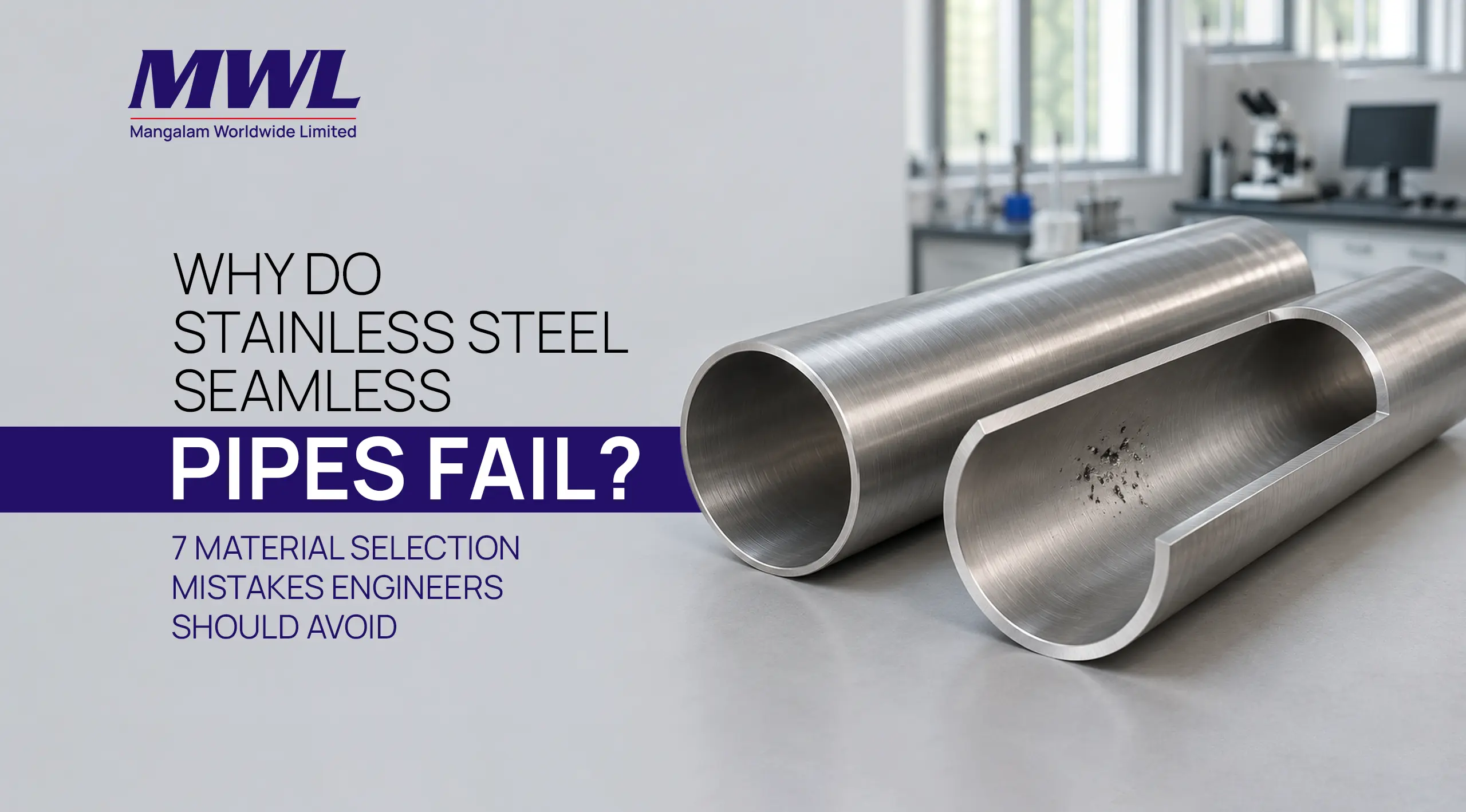
The consequences of a piping failure extend beyond replacing a damaged section. Production interruptions, fluid leakage and unplanned maintenance make the original material selection an important point of investigation.
Stainless steel seamless pipe failure can occur when the selected grade, wall thickness or material condition cannot withstand the actual service environment. Seamless construction eliminates the longitudinal weld seam, but resistance to corrosion, cracking and mechanical damage still depends on the specification, fabrication and operating conditions.
For engineers, effective stainless steel seamless pipe material selection requires looking beyond the grade designation. This article examines seven selection mistakes, explains how they contribute to failure and identifies the checks that can help prevent them.
1. Choosing a Familiar Grade Without Checking Fluid Chemistry
Specifying 304L because it worked on another line overlooks differences in chloride concentration, acidity, contaminants and temperature. Even a familiar process chemical can behave differently when its concentration changes.
Avoid it: Document the actual fluid composition, including cleaning chemicals and impurities. Use corrosion data relevant to those conditions; laboratory results for pure chemicals may not represent a mixed process stream.
Mangalam World wide’s seamless pipe range includes 304/L, 316/L and 321/H, with other alloy families available on request. This gives buyers alternatives to assess against the duty.
2. Treating 316L as a Universal Chloride Solution
Molybdenum improves 316L’s resistance to localized corrosion compared with 304L, but chloride-bearing environments can still cause pitting, crevice corrosion and stress corrosion cracking.
For standard austenitic grades, elevated temperature and tensile stress can make chloride exposure particularly damaging. Specifying a thicker wall does not resolve susceptibility to cracking.
Avoid it: Assess chloride concentration, temperature, crevices and stress together. Evaluate duplex or higher-alloy alternatives where justified, checking their complete service limitations.
3. Selecting Wall Thickness From Pressure Alone
A pipe schedule is a dimensional designation, not a pressure rating independent of grade and temperature. A familiar schedule may provide inadequate capacity when the material, design temperature or required allowances change.
Avoid it: Determine required thickness using the applicable piping code, temperature-dependent allowable stress, manufacturing tolerances and relevant allowances. Assess cyclic loads separately.
Mangalam lists seamless pipes from ¼-inch to 6-inch nominal pipe size. Confirm the exact grade, schedule and dimensional requirements when ordering.
4. Ignoring What Welding Does to the Selected Grade
Seamless pipes still require joining during installation. Certain thermal exposures can cause chromium carbide precipitation in susceptible stainless steels, reducing corrosion resistance near grain boundaries.
Avoid it: Consider low-carbon grades such as 304L or 316L, or stabilized grades where appropriate to the thermal duty. Specify qualified welding and heat-treatment requirements. A low-carbon designation addresses sensitization risk; it does not establish suitability for every temperature or load.
5. Evaluating Only the Inside of the Pipe
A clean process fluid does not protect the outside surface. Wet insulation and salt deposits can create aggressive external conditions. Evaporation on hot surfaces can concentrate chlorides and promote stress corrosion cracking.
Avoid it: Include external exposure in grade selection. Review insulation materials, water ingress, drainage, supports and inspection access alongside the process chemistry. Coastal installations require particular attention to deposited salts.
6. Specifying Chemistry but Leaving Material Condition Unclear
Corrosion performance also depends on microstructure and surface condition. A grade designation alone does not establish that heat treatment, cleanliness and surface preparation suit the application.
Avoid it: Define the required delivery condition and post-fabrication surface treatment. Protect internal surfaces during handling and installation.
Mangalam’s published seamless pipe offering specifies annealed and pickled supply, giving buyers a defined starting condition to incorporate into their project requirements.
7. Accepting Substitutions Without Verifying Material Evidence
A replacement described as “equivalent stainless steel” may differ in composition, heat treatment or mechanical properties. Unverified substitutions undermine the original engineering assessment.
Avoid it: Match material markings and heat numbers to certificates and purchase requirements. Define inspection and acceptance criteria before procurement.
Mangalam documents Mill Test Certificates for product traceability and testing capabilities including positive material identification, ultrasonic testing, hydrostatic testing and tensile testing. Specify which examinations and records the order requires.
Use Failure Evidence to Improve the Next Specification
The causes of stainless steel pipe failure cannot be established from a leak photograph alone. Stainless steel pipe failure analysis should examine service history, material identity, wall measurements, deposits and fracture features.
Common stainless steel piping problems become easier to prevent when those findings inform the next purchase specification.
Discuss your operating conditions, required grades and inspection documentation with Mangalam Worldwide to develop a clearly defined seamless pipe enquiry.