Stainless steel bars are widely used in fabrication, machining, and structural engineering. However, not all stainless steel bars are processed the same way. Two commonly specified forms are bright bars and black bars. While both originate from stainless steel billets, their finishing methods, dimensional accuracy, and industrial use cases differ significantly. Understanding the distinction between bright bars vs black bars helps engineers, procurement teams, and manufacturers choose the appropriate material for performance-driven applications.
This article explains the differences in production, characteristics, and bright bar applications, while highlighting why stainless steel bright bars are preferred for precision engineering environments.
What Are Bright Bars?
Bright bars are stainless steel bars that undergo additional finishing processes after hot rolling. These finishing steps improve surface smoothness, dimensional accuracy, and mechanical properties.
The production of stainless steel bright bars typically involves processes such as cold drawing, centerless grinding, or peeling. These operations remove surface scale and refine the bar’s geometry, producing a smooth, polished appearance.
Key Characteristics of Bright Bars
- High dimensional accuracy
- Smooth, clean surface finish
- Improved straightness
- Enhanced machinability
Because of these attributes, bright bars are commonly used in applications where components must meet precise tolerances.
What Are Black Bars?
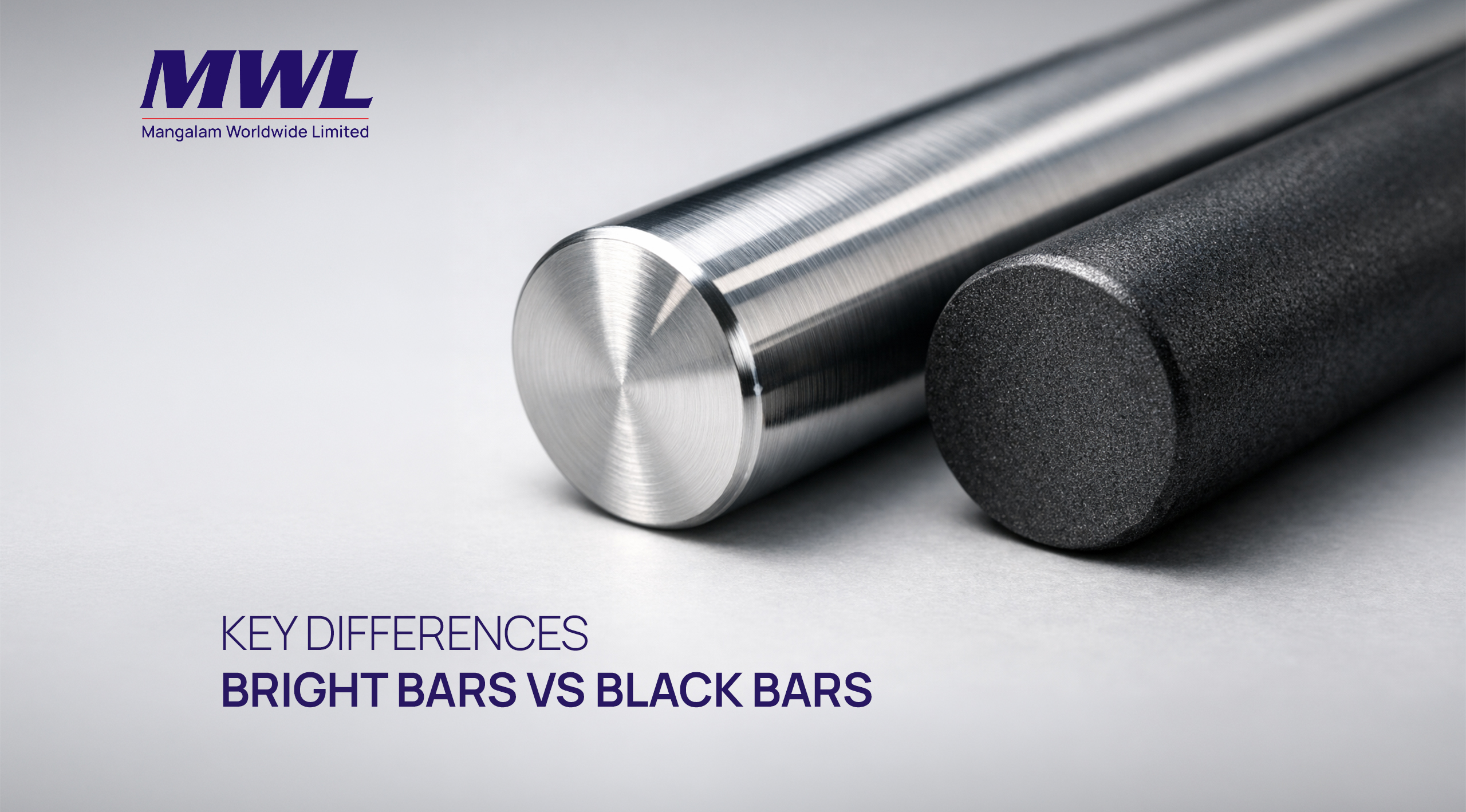
Black bars are stainless steel bars that remain in their hot-rolled condition without undergoing further surface finishing. The term “black” refers to the oxide scale that forms on the surface during the hot rolling process.
These bars maintain the structural strength of stainless steel but do not provide the same level of dimensional precision & surface finish as bright bars.
Key Characteristics of Black Bars
- Rougher surface finish
- Oxide scale on the outer surface
- Wider dimensional tolerances
- Lower processing cost
Black bars are typically used where appearance and tight tolerances are not critical, but structural strength is still required.
Bright Bars vs Black Bars: Key Differences
Understanding bright bars vs black bars requires examining several technical and operational aspects.
1. Manufacturing Process
The primary difference lies in the finishing process.
- Bright bars undergo cold drawing, grinding, or turning after hot rolling to achieve a smooth surface and precise dimensions.
- Black bars remain in the hot-rolled state and do not go through additional finishing operations.
The extra processing in bright bars improves their mechanical properties,surface finish and dimensional reliability.
2. Surface Finish
Surface appearance is one of the most visible differences.
- Stainless steel bright bars feature a smooth, polished finish that is suitable for machining and visible components.
- Black bars have a darker, rougher surface due to the presence of mill scale formed during high-temperature rolling.
This distinction often determines which type is chosen for a specific industrial requirement.
3. Dimensional Accuracy
Bright bars are produced to tighter tolerances compared to black bars.
- Bright bars: Highly accurate diameter and straightness
- Black bars: Wider tolerance range due to hot rolling
Industries that rely on precise engineering components typically prefer bright bars because they reduce the need for additional machining.
4. Mechanical Properties
The cold working processes used in bright bar production can enhance certain mechanical properties.
- Higher tensile strength due to cold drawing
- Improved structural uniformity
- Better machinability for precision parts
Black bars maintain strong structural integrity but may require further machining before being used in precision assemblies.
5. Cost Considerations
Because bright bars require additional finishing processes, they generally cost more than black bars.
However, the higher cost often balances out in manufacturing environments where machining time, waste reduction, and component accuracy are important.
Bright Bar Applications in Industrial Manufacturing
The refined finish and dimensional accuracy of bright bars make them suitable for industries that depend on precision-machined components. Many bright bar applications involve parts that must maintain exact dimensions and consistent performance.
- Automotive Components: Bright bars are commonly used in shafts, fasteners, and precision-engineered automotive parts where reliability and dimensional accuracy are essential.
- Engineering and Machinery: Industrial equipment manufacturers rely on bright bars for machine components, bolts, nuts, and mechanical assemblies.
- Fasteners and Precision Hardware: The smooth surface finish of stainless steel bright bars supports efficient machining and threading, making them suitable for high-performance fasteners.
- Fabrication and Structural Components: Bright bars are also used in fabrication projects where aesthetic finish and mechanical reliability are equally important.
Choosing the Right Stainless Steel Bar
Selecting between bright bars and black bars depends on the requirements of the application.
Black bars are often chosen for structural uses where surface appearance and tight tolerances are less critical. Bright bars, on the other hand, are preferred for machining-intensive industries where precision and consistency directly affect the quality of the final product.
Manufacturers that require reliable stainless steel bars often work with suppliers that maintain strict quality standards throughout the production process. Companies like Mangalam Worldwide focus on delivering stainless steel products with controlled manufacturing, ensuring dimensional accuracy and dependable performance across industrial applications.
Conclusion
When comparing bright bars vs black bars, the difference primarily comes down to finishing processes, dimensional accuracy, and intended application. Black bars offer structural strength in their hot-rolled form, while stainless steel bright bars provide the precision, smooth finish, and machinability required in modern manufacturing. As industries continue to prioritize performance and consistency, the demand for bright bars in high-precision sectors continues to grow.
Looking for high-quality stainless steel bars engineered for industrial performance?
Explore Mangalam Worldwide’s range of stainless steel products and discover reliable solutions designed for precision applications.