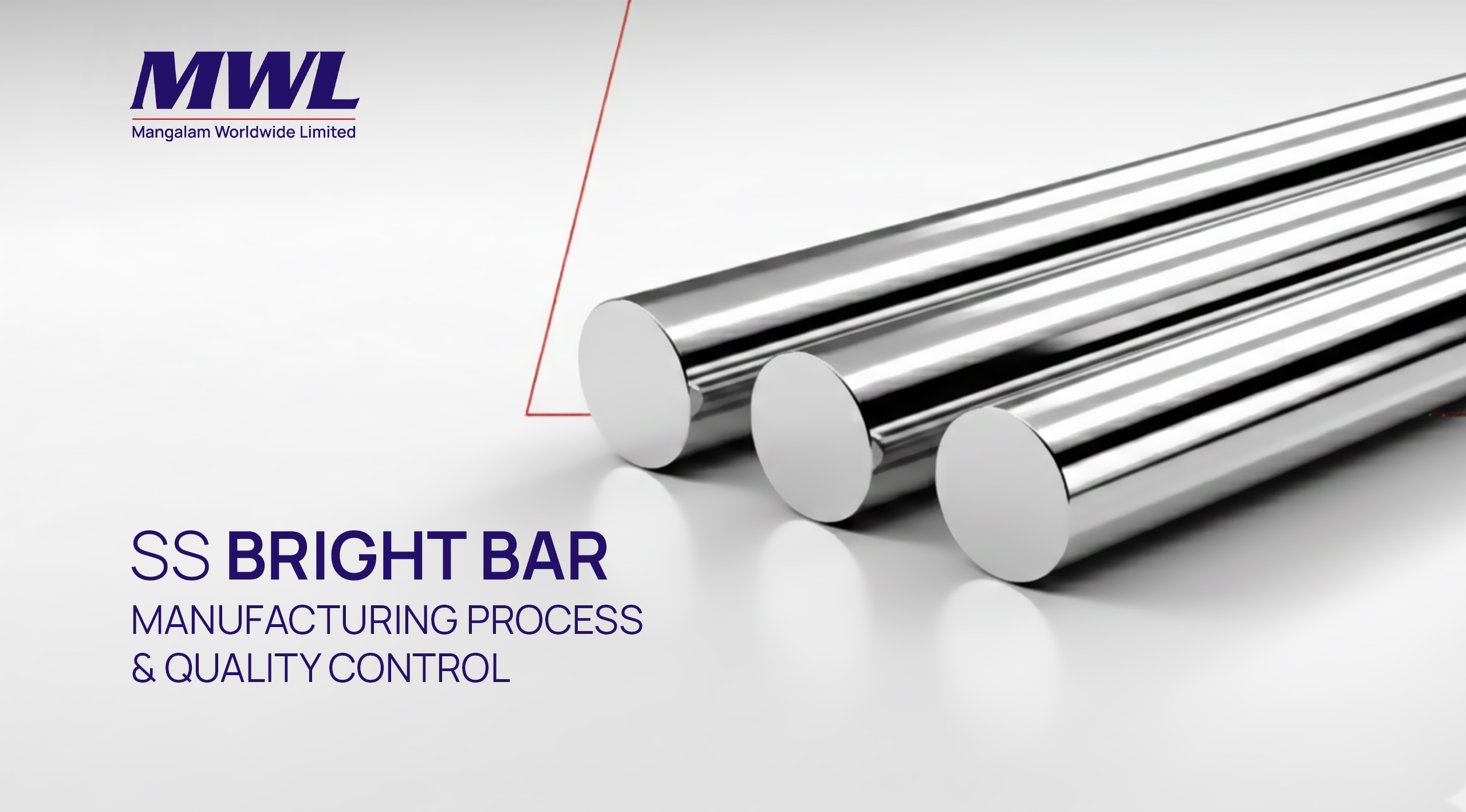
Stainless steel bright bars are integral to industries that depend on accuracy, stability, and superior machinability. Whether used in automotive components, precision fasteners, fabrication assemblies, or heavy-duty equipment, customers expect predictable performance backed by consistent metallurgy. Delivering this level of reliability requires a controlled production system – one that blends material science, mechanical processing, and rigorous inspection. At Mangalam Worldwide, every SS bright bar is produced through a structured sequence of operations that ensures uniformity from the initial billet to the final polished product.
Understanding What Sets SS Bright Bars Apart
An SS bar becomes a bright bar when its surface finish, tolerance levels, and mechanical uniformity reach a higher standard than conventionally processed steel. Bright bars are characterized by:
- Precisely maintained dimensions
- Smooth, refined surface finish
- Enhanced tensile properties
- Better performance during machining and threading
These characteristics make bright bars suitable for parts that demand accurate fitting, stable load-bearing, and long-term durability.
How SS Bright Bars Are Manufactured: Step-by-Step Overview
The production of bright bars is not a single operation; it is a chain of interconnected processes. Each stage influences the next, making consistency a core requirement.
1. Raw Material Verification and Billet Testing
Manufacturing begins with stainless steel billets that must meet grade-specific metallurgical criteria. Before any mechanical processing, each billet is evaluated for:
- Chemical composition
- Structural homogeneity
- Internal soundness through ultrasonic checks
- Surface integrity
This foundation ensures the final SS bright bar retains predictable properties throughout its length.
2. Hot Working: Rolling or Forging
To convert the billet into a workable intermediate bar, controlled hot rolling or forging is performed. At this stage:
- Grain structure becomes refined
- Bars achieve their preliminary shape (round, square, hexagonal)
- Mechanical strength improves due to thermal deformation
Even at this early stage, adherence to temperature accuracy and reduction ratios influences the outcome of later finishing processes.
3. Heat Treatment for Ductility and Stability
Once the initial shaping is complete, the bars undergo a carefully executed heat-treatment cycle. The purpose of annealing is to:
- Relieve internal stresses
- Restore ductility
- Balance hardness across the cross-section
- Prepare the bar for cold-working
Mangalam Worldwide uses calibrated furnaces designed to maintain even thermal distribution, ensuring metallurgical stability throughout the batch.
4. Surface Cleaning and Scale Removal
Any oxide layers or scale formed during hot processing must be removed before precision operations begin. This is achieved through:
- Chemical pickling
- Mechanical descaling
- High-pressure washing (depending on grade and finish requirements)
A clean base surface is essential for consistent dimensional accuracy in later stages.
5. Cold Finishing: Drawing, Grinding, or Turning
This stage defines the quality and identity of a bright bar. Depending on the required finish and tolerance, the bar may undergo:
Cold Drawing
The bar is pulled through dies that shape it to exact dimensions. Benefits include:
- High tolerance control
- Increased tensile strength
- Improved straightness
Centerless Grinding
Grinding machines remove surface irregularities with precision, producing exceptionally smooth bars ideal for machining-sensitive applications.
Peeling or Turning
Certain sizes and grades may require peeling to remove the outer layer and expose a uniform internal surface.
Through these finishing operations, the bar achieves the characteristic bright, polished appearance and dimensional accuracy expected of quality stainless steel bright bars.
6. Straightening and Cutting
Even minor bends can cause problems during machining or assembly. Mechanical straighteners correct alignment imperfections, after which the bars are cut to specified lengths. Clean, burr-free ends ensure the bars are ready for direct industrial use.
SS Bright Bar Quality Control: Ensuring Reliability and Consistency
High-quality stainless steel products rely on disciplined inspection protocols. Mangalam Worldwide integrates quality control at every stage to ensure each SS bright bar meets technical, dimensional, and visual standards.
1. Dimensional Accuracy Evaluation
Precision tools and laser-based measuring systems verify:
- Diameter uniformity
- Straightness
- Tolerance adherence
This ensures compatibility for precision-engineered components.
2. Mechanical Testing
Representative samples undergo property validation, including:
- Tensile strength
- Yield strength
- Elongation
- Hardness levels
These tests confirm that the bars will withstand operational loads without deforming.
3. Surface Integrity Checks
Quality teams evaluate:
- Surface smoothness
- Absence of pits, cracks, and scale
- Uniform brightness
This is especially critical for industries where aesthetics and machinability matter.
4. Non-Destructive Testing (NDT)
Techniques such as eddy current scanning and ultrasonic testing help detect internal discontinuities without damaging the bar.
5. Chemical Composition Certification
Spectrometric analysis confirms that each batch adheres to grade standards, ensuring corrosion resistance and weldability remain intact.
6. Traceability and Documentation
Every bar is traceable through heat numbers, inspection records, and material certificates – reinforcing accountability and long-term reliability.
Conclusion
The production of stainless steel bright bars is a technologically detailed process that requires attention at every step from billet selection to cold finishing and multi-stage inspection. This is why industries trust manufacturers capable of delivering dimensional accuracy, metallurgical stability, and surface perfection with every shipment. With its comprehensive manufacturing capabilities and stringent quality controls, Mangalam Worldwide ensures that each bright bar meets the performance expectations of modern engineering.