Sustainability in manufacturing is not only about reducing the environmental impact of production. It also involves selecting materials that remain functional for longer, require fewer replacements and retain value when equipment eventually reaches the end of its service life.
This lifecycle perspective makes sustainable stainless steel particularly relevant to industrial material selection. Its corrosion resistance, mechanical performance, long service life and recyclability can help manufacturers reduce repeated material consumption while supporting equipment reliability. For buyers evaluating sustainable industrial materials, durability is therefore an important part of the decision.
Why Durability Matters in Sustainable Manufacturing
Every premature component replacement has a material consequence. A replacement part requires new raw materials, manufacturing, processing, transportation and installation. Extending service life can reduce how frequently these activities need to be repeated.
Stainless steel durability is strongly connected to its corrosion resistance. Chromium in stainless steel forms a passive surface layer that helps protect the underlying material from corrosion. Depending on the grade and service environment, additional alloying elements can provide further corrosion and mechanical performance.
For industrial equipment, this can translate into longer service intervals and fewer replacements when the correct stainless steel grade is specified.
The sustainability benefit is straightforward: a long-lasting stainless steel component can continue performing its intended function rather than being replaced simply because the material has deteriorated prematurely.
Stainless Steel Sustainability Extends Across the Lifecycle
A meaningful assessment of stainless steel sustainability should consider more than the initial manufacturing stage. Life Cycle Assessment evaluates environmental impacts from raw material extraction and production through the use phase and eventual recovery.
During service, durable stainless steel can contribute through:
- Long operating life in appropriately selected applications
- Resistance to corrosion and environmental degradation
- Reduced need for replacement materials
- Relatively low maintenance requirements
- Avoidance of protective coatings in many applications
- Recovery and recycling after the useful service period
These characteristics can make lifecycle performance particularly important when stainless steel is specified for process equipment, piping, infrastructure and other assets expected to remain operational for extended periods.
Recyclability Keeps Material in Circulation
Durability addresses how long a product remains useful. Stainless steel recyclability addresses what happens after that useful life ends.
Stainless steel can be recycled repeatedly without losing the fundamental properties that make it valuable as an engineering material. According to world stainless, around 95% of stainless steel at end of life is collected and recycled, while new stainless steel contains approximately 48% recycled scrap on average globally.
This makes stainless steel recycling more than a waste-management consideration. Recovered stainless steel becomes a valuable input for future production rather than automatically entering a linear take-make-dispose system.
Supporting the Stainless Steel Circular Economy
A stainless steel circular economy depends on keeping material useful for as long as practical and then recovering its value at the end of service.
Stainless steel supports both stages. Its durability delays the need for replacement, while its recyclability enables recovered material to return to the production cycle.
This distinction matters. Rapid replacement followed by recycling still requires repeated manufacturing activity. A material that combines a long useful life with effective end-of-life recovery addresses both resource longevity and material circularity.
For sustainable manufacturing, engineers and procurement teams should therefore consider service life, maintenance requirements and end-of-life potential alongside initial material cost.
Grade Selection Is Part of Sustainable Material Use
Stainless steel does not deliver the same performance in every environment. Selecting an unsuitable grade can shorten service life, while unnecessary over-specification can increase alloy use and project cost without providing meaningful application benefits.
The operating environment should guide the choice. Factors such as temperature, corrosive media, mechanical loading, fabrication requirements and required product life need to be considered.
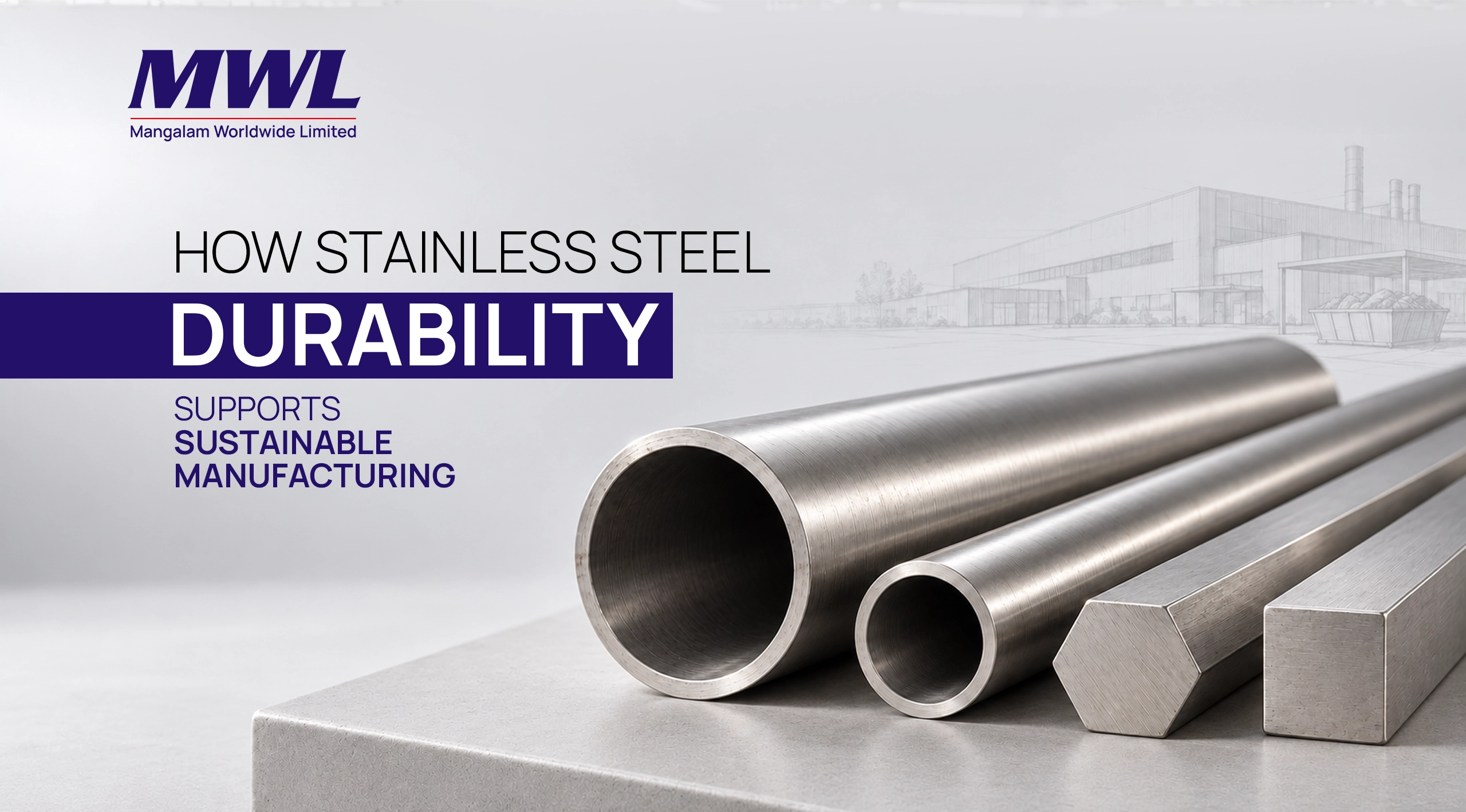
Mangalam Worldwide manufactures a broad range of Austenitic, Ferritic, Martensitic, Duplex, Super Duplex and High Alloy stainless steel grades. Its integrated operations extend from melting and rolling to downstream processing, providing control over chemistry and product quality across multiple stainless steel forms.
Its portfolio includes billets, bright and hot-rolled bars, forged products, seamless and welded pipes and tubes, heat exchanger tubes and other stainless steel products, enabling grade and product form to be matched more closely with application requirements.
How Mangalam Worldwide Supports Responsible Manufacturing
Material durability needs to be supported by manufacturing consistency and quality control. Mangalam Worldwide uses in-process and finished-product quality checks, while Mill Test Certificates provide traceability from raw material to finished product. The company also holds ISO 14001:2015 environmental management certification.
Mangalam Worldwide also states that it continually evaluates energy-efficiency initiatives and seeks to increase the use of green energy within its manufacturing approach.
Conclusion
The role of stainless steel in sustainable manufacturing is built on a combination of performance and lifecycle value. Stainless steel durability can extend component life and reduce replacement requirements, while stainless steel recyclability helps retain valuable material after service.
Choosing the correct grade and product specification allows manufacturers to make better use of these advantages while meeting their technical requirements.
Make Durability Part of Your Material Strategy
Looking for stainless steel that combines application-specific performance with long-term material value?
Mangalam Worldwide offers a broad portfolio of stainless steel grades and product forms backed by integrated manufacturing and quality control.
Share your grade, product, specification, and application requirements with Mangalam Worldwide today to source stainless steel engineered for reliable, long-term performance.